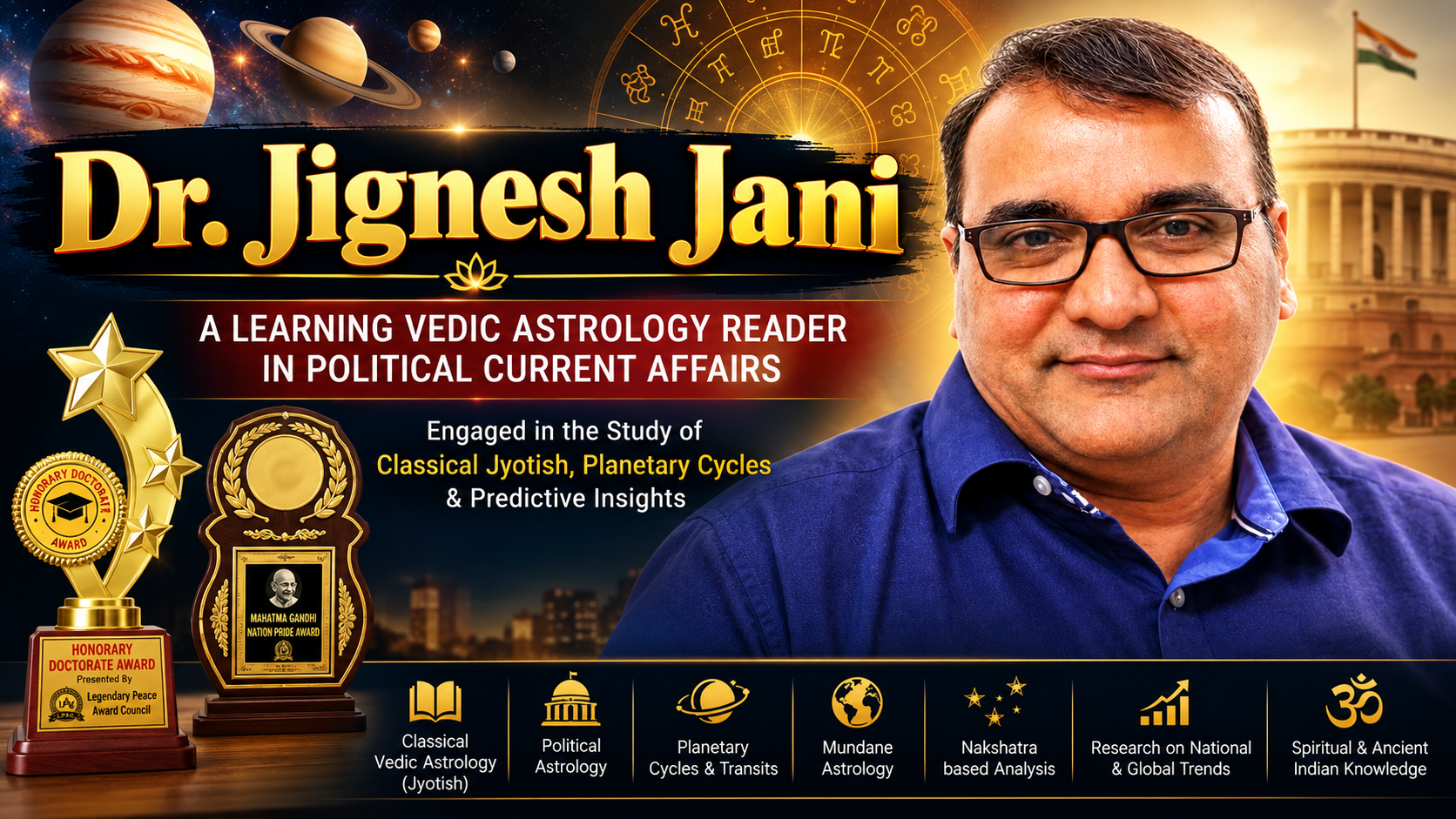
Ahmedabad | July 10, 2026: As discussions around global politics, economic uncertainty, and international relations continue to evolve, Vedic astrology researcher Jignesh Jani has shared his perspective on how traditional Jyotish interprets broad global developments. According to Jani, Vedic astrology offers a symbolic framework for understanding collective cycles but should not be regarded as a scientifically established method for predicting specific geopolitical events.
Jani explained that Vedic astrology has been practiced for centuries to study planetary movements and their symbolic associations with human affairs. Many astrologers believe that certain planetary combinations correspond with periods of transformation, policy changes, and increased international activity. However, he emphasized that these interpretations are philosophical and cultural rather than evidence-based forecasts.
Referring to the current planetary positions, Jani noted that the Mars–Rahu conjunction, traditionally known as Angarak Yoga, is interpreted by many practitioners as representing assertive energy, strategic decisions, and heightened geopolitical activity. Likewise, the Saturn–Neptune alignment is often associated with institutional restructuring, ideological shifts, and evolving global alliances.
Jani also highlighted the traditional significance of Jupiter in Vedic astrology. Considered a planet representing wisdom, ethics, justice, and diplomacy, Jupiter is viewed by many astrologers as a positive influence that encourages dialogue, balanced leadership, and peaceful conflict resolution during uncertain periods.
According to Jani, the present international environment is characterized by economic challenges, changing strategic partnerships, technological competition, and ongoing diplomatic negotiations. While astrology may symbolically reflect these broader themes, he reiterated that actual geopolitical developments are determined by political decisions, economic conditions, military strategies, and diplomatic efforts.
“Astrology can inspire reflection on larger cycles, but it should never replace factual analysis or responsible policymaking,” Jani said. “The future is shaped by human choices, international cooperation, and the commitment of leaders to resolve differences through dialogue.”
Jani concluded by encouraging readers to appreciate Vedic astrology as part of India’s rich cultural heritage while maintaining a clear distinction between symbolic interpretation and evidence-based geopolitical analysis. He expressed hope that diplomacy, mutual respect, and global cooperation will continue to guide international relations in the years ahead.