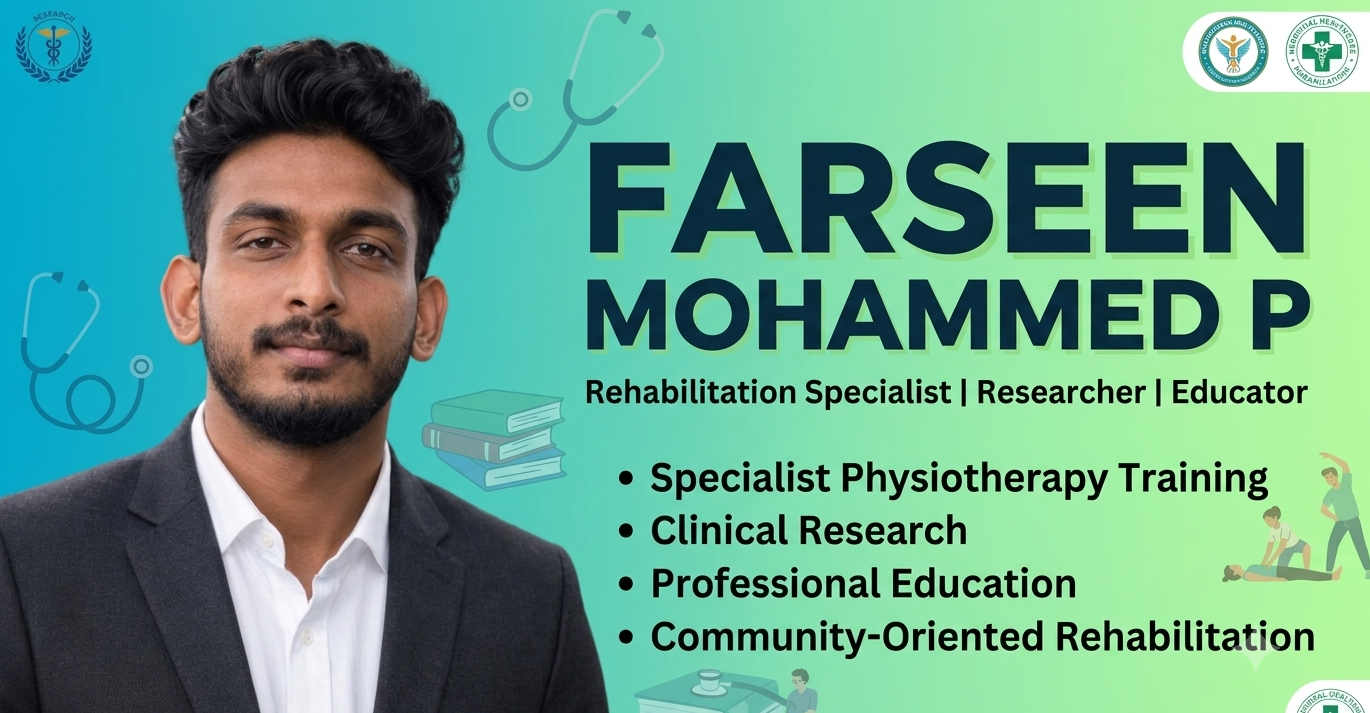
Anchal, Kerala: Professional education plays an important role in healthcare, helping clinicians and healthcare teams remain informed about developments in patient care and rehabilitation. In September 2026, physiotherapist and clinical researcher Farseen Mohammed P participated in a continuing medical education programme for nursing professionals at St. Joseph’s Mission Hospital, Anchal, Kerala, serving as a resource person for a session focused on rehabilitation after hospital discharge.
The session provided an opportunity for Farseen to share perspectives from his background in neuroscience physiotherapy, neurorehabilitation and evidence-based rehabilitation.
CME Session on 5 September 2026
Farseen served as a resource person at a CME programme held on 5 September 2026 at St. Joseph’s Mission Hospital, Anchal, Kerala.
His session was titled:
“Life After Discharge: Physiotherapy-Guided Secondary Prevention and Community Reintegration.”
The topic addressed an important stage of healthcare—the period after a patient leaves the hospital and begins transitioning back to home, family and community life.
Sharing Physiotherapy Perspectives
As a physiotherapist specializing in neurosciences, Farseen has developed professional interests in neurorehabilitation, therapeutic exercise and functional recovery.
His postgraduate clinical training at Yenepoya Medical College Hospital, Mangaluru, included exposure to neurological conditions such as stroke, Parkinson’s disease, traumatic brain injury, Guillain–Barré syndrome and spinal cord disorders.
This background provided a clinical foundation for his participation in discussions surrounding rehabilitation and post-discharge care.
Importance of Rehabilitation After Discharge
For many patients, discharge from a hospital marks the beginning of another phase of recovery rather than the end of rehabilitation.
Depending on the individual’s condition, rehabilitation may continue through physiotherapy, exercise, mobility training and functional activities.
The session addressed the broader concept of life after discharge, with attention to physiotherapy-guided secondary prevention and community reintegration.
Engaging With Nursing Professionals
The CME programme brought Farseen’s physiotherapy perspective into an educational setting involving nursing professionals.
Nurses and physiotherapists frequently contribute to different aspects of patient care, making communication and professional knowledge-sharing important components of multidisciplinary healthcare.
By participating as a resource person, Farseen had an opportunity to discuss rehabilitation-related considerations with professionals involved in patient care.
Community Reintegration
One of the central themes of his presentation was community reintegration.
For patients recovering from neurological or other disabling conditions, returning to the community can involve challenges related to mobility, daily activities, physical participation and independence.
Rehabilitation can therefore extend beyond the immediate clinical environment.
The subject of Farseen’s presentation reflected this wider view of recovery and the role physiotherapy may play in supporting patients after discharge.
Connection With Neuroscience Physiotherapy
Farseen’s specialization in neuroscience physiotherapy is particularly relevant to discussions around long-term rehabilitation.
During his postgraduate clinical training, he gained experience in neurological rehabilitation involving stroke, Parkinson’s disease, traumatic brain injury, Guillain–Barré syndrome and spinal cord disorders.
His academic and research interests have also focused on neurological rehabilitation.
Stroke rehabilitation and Parkinson’s disease rehabilitation are among the major areas represented in his research portfolio.
Research-Oriented Professional Profile
Alongside clinical physiotherapy, Farseen has developed a research-oriented professional profile.
His research interests include systematic reviews, scoping reviews, evidence synthesis and clinical intervention research.
He has worked on research related to stroke rehabilitation and Parkinson’s disease, while his broader interests include therapeutic exercise and evidence-based physiotherapy.
This combination of clinical and research interests contributes to his approach toward professional education.
Experience in Scientific Communication
The CME session adds to Farseen’s experience in scientific and professional communication.
In 2026, he has participated in physiotherapy conferences and presented research in oral paper categories.
At Mangalore PhysioCon 2026, he presented his postgraduate research on eccentric versus concentric strengthening and functional mobility in subacute stroke patients.
At SYNERGOS 2026, he presented a systematic review concerning eccentric strengthening interventions in stroke rehabilitation and received the first prize in the postgraduate oral paper presentation category.
These experiences have provided opportunities to communicate research and rehabilitation topics to professional audiences.
Continuing Professional Development
Farseen’s role as a CME resource person forms part of a wider pattern of continuing professional development.
His 2026 activities include research presentations, clinical education, professional workshops and research-methodology training.
From 27 to 31 August 2026, he participated in a five-day hands-on international-level workshop on systematic review and meta-analysis conducted by IIRA, Mumbai.
He has also completed training related to Good Clinical Practice and health science research and publication.
From Clinical Practice to Professional Education
Healthcare professionals often develop their expertise through a combination of academic education, clinical experience, research and knowledge-sharing.
Farseen’s professional development reflects this combination.
His postgraduate specialization established a foundation in neuroscience physiotherapy, while clinical training provided practical exposure to neurological rehabilitation.
His research activities have subsequently expanded into evidence synthesis and clinical research.
Serving as a CME resource person represents another aspect of this development—sharing professional knowledge with other members of the healthcare community.
A Focus on Continuity of Rehabilitation
The theme of Farseen’s CME session also reflects the importance of continuity in rehabilitation.
A patient’s functional goals and rehabilitation needs may continue after hospital discharge.
Physiotherapy can be part of the broader process of helping appropriate patients maintain or improve physical function and participate in daily life, according to individual clinical requirements.
The focus on secondary prevention and community reintegration therefore connects clinical rehabilitation with the realities of life outside the hospital.
Building a Career in Physiotherapy and Research
Farseen Mohammed P is developing his professional career at the intersection of physiotherapy, neuroscience rehabilitation and clinical research.
His involvement as a CME resource person demonstrates an interest not only in clinical and academic work but also in professional knowledge-sharing.
With continuing activities in research, scientific presentations, clinical education and evidence-based physiotherapy, he is building a profile that combines patient-focused rehabilitation with academic development.
Looking Ahead
The September 2026 CME programme at St. Joseph’s Mission Hospital represents another milestone in Farseen Mohammed P’s professional journey.
His role as a resource person provided an opportunity to discuss the importance of physiotherapy-guided rehabilitation after hospital discharge and the broader goal of community reintegration.
As he continues to develop his career in neuroscience physiotherapy and clinical research, professional education and knowledge-sharing are likely to remain important components of his ongoing development.